

AI and the Most Important Abundance: Life
Join us for a special conversation with NVIDIA's Vice President of Healthcare

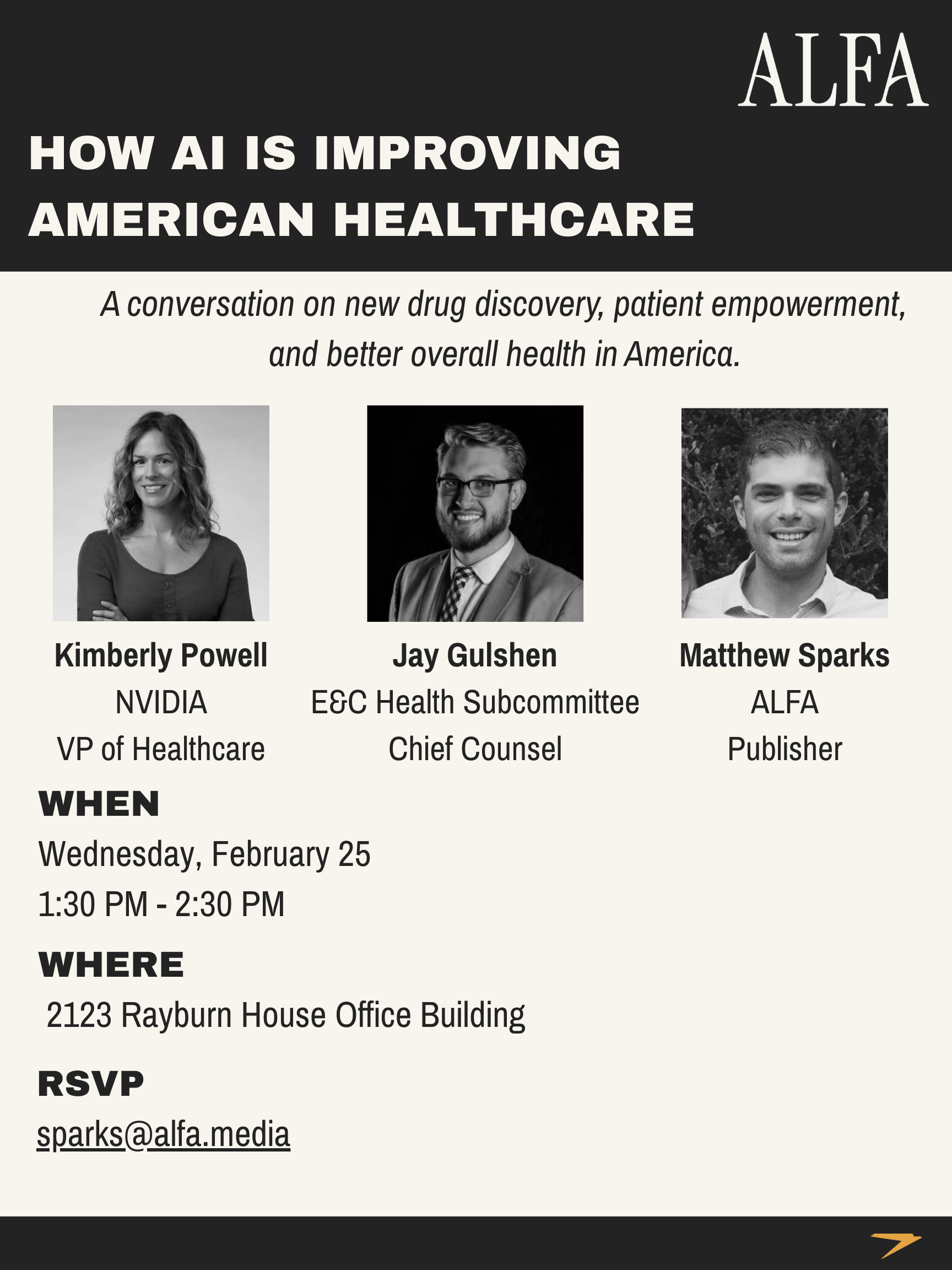
Next week, ALFA is hosting a conversation on Capitol Hill with NVIDIA Vice President of Healthcare, Kimberly Powell, and House Energy and Commerce Health Subcommittee Chief Counsel, Jay Gulshen.
Why This Conversation Matters
By far, the most promising application of AI is in how we discover and treat diseases. A quote I’ve been thinking about a lot as we’ve put this event together is, “A healthy man wants many things; a sick man wants only one.” Its power is in its universality—from the terminally ill to the temporarily sick.
And so when the narrative around AI is abundance across, well, everything, it’s important to center on the most important thing, which in the mortal world is human life.
Former Nebraska Senator Ben Sasse, who late last year revealed he had stage-four pancreatic cancer, recently joined the Hoover Institute’s “Uncommon Knowledge” podcast, which aired this week. It’s a heavy conversation but one worth listening to (for many reasons beyond the topic of pancreatic cancer and current treatment trials).
Sasse notes that while we are not short on knowledge in this world, there is plenty more we can and need to understand; treating and curing pancreatic cancer being one of personal significance to him and the 67,000 other people diagnosed with it each year.
Artificial intelligence offers us that opportunity and NVIDIA’s work with MD Anderson and Eli Lilly are clear examples of how. We look forward to Kimberly sharing more about these partnerships and the many others the company is leading. Understanding this landscape should help focus the government’s research, funding, and regulatory priorities.
The timing of this is important. The last major health research initiative taken up by Congress—the 21st Century Cures Act—became law in 2016, just a year after OpenAI was founded and five years before Anthropic.
But like all great policy and technology ambitions, it’s more than just about the what or the how. As Sasse reminds us, our attention should not be so much focused on gaining the “freedom from something” but rather on the “freedom to something.”
Freedom from pain and disease is absolutely the most acute goal in a time of illness. But it’s not the last goal. Sasse doesn’t want to live longer to give more speeches, write more essays, or take on more jobs. He, like everyone else facing mortality, wants the freedom to see his son get his driver’s license, walk his daughters down the aisle, and hold his future grandchildren.
AI’s opportunity in health care isn’t just about freedom from disease. It’s a freedom to live and give that life in service to others.
We hope you will join us as Kimberly and Jay show us how the right approach to technology and policy can help make that happen.