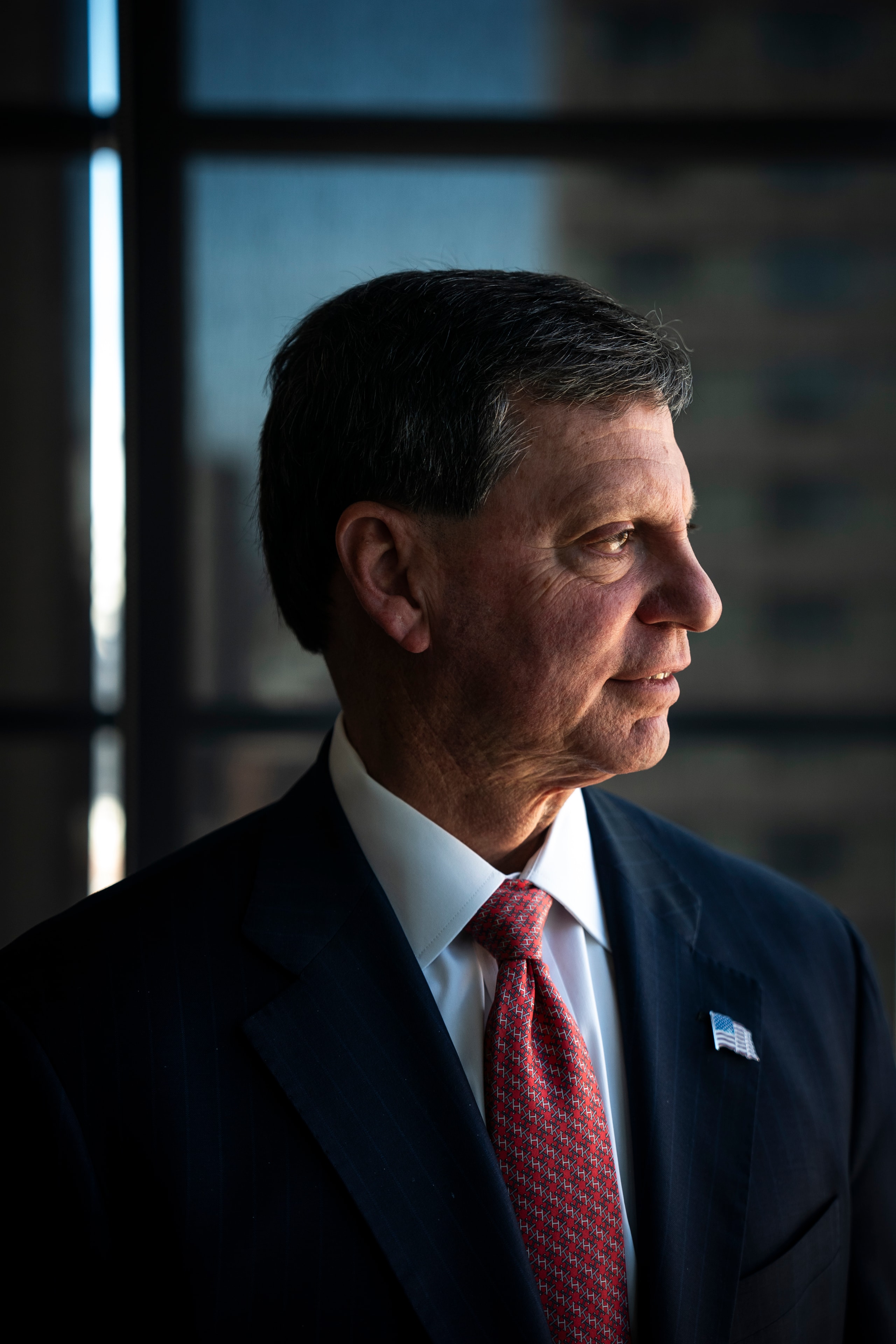
The Man With a Plan
Frank Bisignano's life has prepared him for his toughest test yet
The federal government has long been a technological backwater, and few agencies have been stuck in the mud as badly as the Social Security Administration (SSA).
For decades, the huge benefits bureaucracy has relied on 1980s-era IBM mainframe systems. It has run core processes on a 60-million-line codebase written in COBOL, a 65-year-old programming language that few people know anymore. The agency stores some archival data not in the cloud but in paper files stacked in limestone caves in western Missouri. Service for the tens of millions beneficiaries can be glacial.
The man in charge of changing that, and transforming the Social Security Administration, is Frank Bisignano, a legendary Wall Street operations and technology savant who's rescued a series of companies from disaster, often under the toughest of circumstances. His record of success is crucial for the New Deal-era program, which faces existential threats from the financial burdens of the Baby Boomers' retirement.
Bisignano's resume includes successfully steering Citigroup -- then the nation's largest bank -- and its employees through the tragedy and tumult of 9/11, when he literally led thousands of workers safely away from Ground Zero with a bullhorn and a plan developed years in advance.
He helped guide J.P. Morgan Chase through the dizzying 2008 financial crisis and its aftermath. In the process he helped to save the housing market and the economy from collapse.
And in his first turn as a company CEO, he rescued a flailing payment processor, First Data Corp., from drowning in debt.
At every step of his career, Bisignano has leaned on two powerful advantages: technology and his team.
Leveraging the latest technology -- from the web to ecommerce to the cloud to AI -- and empowering his people to make decisions has allowed him time and again to come from behind and pull out the win. That playbook is no different at Social Security today where he is putting into action some longtime priorities of President Trump's tech advisers who have advocated for transformation of the federal bureaucracy, along the lines of major private-sector businesses. That could help the government and agencies like Social Security break their cycle of overspending on maintaining expensive legacy systems, and invest more in new systems, especially the cloud and artificial intelligence.
"You've got to always be forward-looking," Bisignano said in a recent interview. "You're going to create change, so you've got to spend your time looking around corners, seeing what's next and being prepared for it."
But Bisignano is also putting his own spin on the administration's tech principles, which early on were framed as friendlier to tech than human capital. Instead, he's using a digital-first approach that also prioritizes people.
Even as many agencies have seen their headcounts drop, he's designed systems around empowering staff and consumers, said Michael Russo, the agency's CIO. Technology "is not a replacement for people, it's a way to do things better and faster," Russo added.
This belief was the reason Bisignano ensured that Social Security was one of the first agencies to partner with the Office of Personnel Management's "Tech Force," a government-wide mission to recruit and encourage young, technology-forward workers to join the federal government. The program's aim is to make the federal government -- long viewed as a wasteland by tech's best and brightest -- into the place "where all the cool kids go," says Scott Kupor, the OPM director.
While the Social Security Administration might not be the easiest sell for those young techies, it does present some of the government's most important and complex problems.
"There is nothing more important that Frank is doing other than tech modernization," Kupor adds.
So far, Bisignano -- who entered his second year as commissioner on May 7 -- has found early success. He's slashed the notoriously long wait times for phone calls to the agency, and significantly improved the results that callers are getting. He's vastly increased the number of issues being handled on the agency's website, while also improving site performance by many measures. Account registrations have soared.
The agency has turned into a cutting-edge testing ground for real-world uses of artificial intelligence to speed up casefile processing. (The Social Security disability program alone receives 750,000 pages of medical records a day, making an automated system for summarizing it an urgent priority.)
Soon, he'll be rolling out a seemingly obvious, yet persistently vexing project: a digital Social Security app.
Overhauling the Social Security Administration is just one of the challenges Bisignano has been handed by the Trump administration. More recently, he's also been named CEO of the Internal Revenue Service, an agency that is also in the technological dark ages. Parts of it are operating on mainframe systems that date back to the 1960s.
Both agencies are vital to the nation's looming fiscal struggle. Social Security, the federal government's largest single program, already has been running in the red for the last five years. It is projected to go through the last of its financial reserves by about 2034, just eight years from now. Preventing calamity will likely require Congress to make tough decisions that have been avoided to date: some combination of benefits reforms, higher taxes, and technology-based efficiencies.
The IRS, meanwhile, is the government's money machine, generating about 95 percent of all federal revenue. But it's currently unable to collect at least $700 billion in unpaid taxes each year, another problem that technology might be able to help solve.
Bisignano is betting his efforts will put the two agencies on firmer footing to handle the challenges they face.
He is characteristically upbeat about succeeding.
Looking back on his long career spent saving companies that faced disaster, he said in a recent interview at the agency's Woodlawn headquarters: "It makes me quite confident. In an odd way I'm conditioned for this work."
His conditioning began early. Bisignano grew up in Mill Basin, a secluded suburban corner of Brooklyn near Jamaica Bay. His father was a lifelong federal employee, mostly at the U.S. Treasury. He would leave the house by 5 a.m., and sometimes worked a double shift. Bisignano's mother fashioned a successful career at a stevedoring company, bossing around burly longshoremen. His maternal grandfather, who had emigrated from Italy and joined the U.S. Army in World War I to gain his citizenship, also lived with the family.
"They were workers," Bisignano recalls of his parents. "They were going to make a nice little life for their family. And it was never about money, it was in pursuit of doing something good."
One of the pursuits they excelled in was athletics. An uncle, Joey Giardello, was the middleweight boxing champion of the world for a few years in the 1960s, defeating the likes of Sugar Ray Robinson, Dick Tiger, and Rubin "Hurricane" Carter with his clever counterattacks and ability to avoid trouble. Another uncle became a member of the National Senior Softball Hall of Fame.
Bisignano was an accomplished athlete himself, excelling at baseball, and later making his mark in the then-popular sport of bowling. It's hard to imagine now, but bowling was one of the most popular sports in America during the mid-to-late 1970s, boasting over 65 million participants at its peak. It was the single most-played recreational sport in the country.
Its popularity was boosted by television, with ABC's Pro Bowlers Tour being a cornerstone of weekend afternoon programming starting in the early 60s and continuing to dominate Saturday TV throughout the 70s, regularly pulling in audiences of 10-15 million viewers per broadcast.
Bisignano did well enough in bowling to win a city championship for his high school team, making a difficult split to clinch the victory. Given the sport's popularity it appeared to many that his career would be made in the lanes. Great bowlers made good money, and Bisignano started to see that through wagers he placed on himself during local and regional competitions.
Starting in 1977 Bisignano attended Baker University in Kansas, a power in collegiate bowling. He became nationally ranked, strengthening the impression by many that the professional circuit was his future.
"Everyone thought that was the outcome for me," he recalled in a recent interview. "Except me."
Bisignano, who majored in finance at Baker, got a summer internship at Bear Stearns (a company he would one day help to take over during the financial crisis). He was shocked to find that people thought he -- a kid from Brooklyn best known for his bowling skills -- had potential in banking.
But he also had noticed that even the most successful bowlers drove themselves from tournament to tournament, often sleeping in their RVs. They went to work in dingy bowling alleys and ate greasy food. Even for consistent winners, the money wasn't what bankers made.
So Bisignano decided to give Wall Street a chance. He was seeing around a corner -- a talent that would serve him well in his long career.
At his first job at a big firm, Shearson Lehman/American Express, Bisignano quickly established himself as someone who handled pressure well, particularly in a crisis.
"Give it to Frankie, he'll fix it," they said.
An early test came when his bosses at Shearson discovered the firm had made a terrible mistake: officials had sent the wrong tax information to the IRS for their client list. Clients themselves received the correct investment-income information, but the computer tape the firm sent to the IRS showed a list of its clients and their investment income -- except all the income information was off by one line.
Bisignano, whose job became unraveling the tangle, remembers that more than one million customer accounts were affected. Letters had to be mailed, call centers had to be set up and run, service representatives had to be trained and supervised.
It was "an incredible mess," recalls Tony DeMeo, a colleague at the time. "That's when I think he really shined."
Bisignano also played a major role in executing several complex mergers, including the firm's 1987 acquisition of E.F. Hutton -- a deal that created the nation's largest retail brokerage.
Bisignano kept a hawkish eye on expenses and knew his numbers cold -- traits that endeared him to the firm's data-obsessed leaders, including Sanford "Sandy" Weill and future JPMorgan Chase CEO Jamie Dimon.
The detail-oriented Bisignano "was actually a pain in the ass, but a good pain in the ass," DeMeo recalls. "He reeled us in and made sure we didn't get too far out of the box."
Bisignano also became a star on the legendary company softball team -- drawn from the firm's Italian-American employees -- that DeMeo helped organize. Players called themselves the "Paisanos" and wore pizza makers' floppy white hats instead of ball caps.
They played games at a Brooklyn little league field against another company team organized by CEO Peter Cohen that was nicknamed the "Cohen-heads," after the Saturday Night Live "Coneheads" skit. According to DeMeo, the Paisanos never lost.
In 1990, Bisignano moved on to his next cleanup job, helping to rebuild a regional banking powerhouse in New Jersey, First Fidelity, that had run aground because of bad commercial loans. He quickly rose to be in charge of one-third of the bank.
But when the offer came to join Dimon and Weill again -- this time at Smith Barney, as chief of operations -- Bisignano jumped at the chance. He was eager to be part of something bigger, even if it meant returning to operations. "I wanted to take the biggest challenge," Bisignano recalls now.
In 1998, he became co-head of global operations and technology at Smith Barney, eventually rising to head of global operations and information technology for parent Citigroup. In August of 2000 he succeeded Robert Druskin as chief administrative officer of Citigroup, then the nation's largest bank. He was barely 40.
As part of his growing responsibilities, Bisignano had begun taking a role in planning for possible disasters. He and Druskin discussed with their team what to do if the Twin Towers were destroyed.
This wasn't an unimaginable scenario -- the North Tower parking garage had been bombed by terrorists in 1993, killing six people and causing significant damage.
In the process of gaming it out, Bisignano went against his money-saving instincts. He pushed back on a proposal to create a new data center for the growing firm at 7 World Trade Center, a 47-floor building where newly-acquired Salomon Brothers was the anchor tenant. Bisignano viewed the location as too vulnerable, given tech's importance to the firm's operations.
"I just hated the idea of a data center in the sky," he explained.
When the first passenger jet hit the North Tower on the morning of Sept. 11, 2001, Bisignano was heading to a staff meeting in Lower Manhattan. He picked up the phone and called a high-ranking company executive whose office was on the top floor of 7 World Trade Center. The building was just 370 feet from the now-burning North Tower. Bisignano told the executive that the firm needed to evacuate. The executive said they'd been told to stay put. Bisignano persisted.
Eventually, thousands of Citigroup employees began trooping out of the building. They got out just ahead of the South Tower's collapse around 9:59 a.m. The North Tower fell soon after.
The 7 World Trade Center building collapsed later that afternoon, engulfed in flames caused by burning North Tower debris. Citigroup lost six employees, all of them reportedly visiting other firms' offices inside the Twin Towers.
Using a bullhorn, Bisignano steered 16,000 Citigroup employees who worked around the Financial District toward the company's emergency facilities at 34th Street near Penn Station. "Head north!" he yelled.
Bisignano himself stayed behind in Lower Manhattan for the duration of the emergency, as he sought to manage connectivity and prepare Citi for a return to business in the coming days.
Citi continued operations and was ready for securities trading to resume when markets reopened on Sept. 17.
"You move more money than anyone, you better be prepared," Bisignano says now.
The company's year-end letter to shareholders singled out Bisignano and Druskin, who co-led the Disaster Recovery team, for special praise. "They were called into action within minutes of the disaster and made it possible for us to continue working on behalf of our clients, our shareholders and our markets," Chairman Weill wrote. He offered his "heartfelt thanks and admiration."
In his letter, Weill also praised the company's cost-cutting measures, which were on track to find $1 billion in savings in part by "leveraging technology."
Bisignano's first real chance to apply his ideas about technology as a chief executive came when he was given an additional assignment -- running Citigroup's Global Transaction Services division, an ambitious but money-losing effort to connect the world commercially via the internet.
At the beginning of Bisignano's tenure in 2002, Global Transaction Services was running a loss of $400 million. By the time he exited the business in 2005 it was running a profit of more than $1 billion and had grown its revenue from $4 billion to $6 billion annually.
As he would do often throughout his career, Bisignano achieved success not by reinventing wheels, but by leaning into existing technology initiatives that showed promise, but hadn't yet reached their potential.
By the time the financial crisis struck a couple of years later, Citi had far outstripped every other global bank's efforts to connect the world.
In a foreshadowing of Bisignano's future role at Social Security, GTS began distributing pension payments and other payments for many foreign governments, including in Western Europe.
GTS did so well that company executives had to politely request that its people stop describing the division as the company's "crown jewel," in order to minimize internal jealousies.
The success led to yet another recruiting effort for Bisignano's services, this time from Dimon, who had left to run Bank One in Chicago, then an up-and-comer and the fifth largest U.S. bank. Weill countered by offering to double Bisignano's salary and give him a sizable signing bonus.
It was a lot of money for a kid from Mill Basin, Brooklyn. But Bisignano worried about the impact on his relationship with Dimon if he turned down the offer to move.
"It was one of those moments that I had to go get wisdom from my dad," Bisignano said. "My dad told me, 'If they're your friends like they say they are, they'll understand.'"
Bisignano stayed at Citi. Dimon said he understood. And Bisignano committed that when Dimon came back to New York, he would go to work for him.
It didn't take long.
In 2005, Bisignano agreed to join Dimon at JPMorgan Chase, where Dimon was about to become CEO. JPMorgan Chase was widely viewed as the new challenger to Citigroup.
But -- much like Citigroup a few years earlier -- JPMorgan was hastily stitched together from a number of other firms, leaving operational gaps and inefficiencies. Its nucleus had been formed when JP Morgan merged with Chase Manhattan in 2000, and then acquired Bank One in 2004.
The resulting conglomerate was known for being disorganized as well as lackluster at financial technology -- which had become Bisignano's specialty. Reorganizing and rewiring JPMorgan Chase became his first big opportunity there.
Even bigger challenges came in the country's financial crisis in 2008. It was triggered by a meltdown in the byzantine mortgage-backed securities market, and soon became a threat to the financial system and the economy itself.
When the crisis hit, Bisignano was ready. He and his team had seen signs of trouble in some early investment fund collapses the year before.
"We extrapolated it out -- what would happen if a large institution failed?" he recalled. Executives tested and practiced their plans, helping JPMorgan Chase be ready when the storm hit.
Ultimately, JPMorgan Chase was widely viewed as one of the best-prepared and most successful institutions in the financial crisis. Bisignano was among the executives described in a Fortune cover story as "The Survivors."
JPMorgan Chase even strengthened its competitive position by acquiring two collapsing rivals, Bear Stearns and Washington Mutual.
It emerged from the tumult as the largest bank in the United States. Bisignano himself was a player in the bank's move to buy Bear in March of 2008. Within days of the Bear takeover, Bisignano had workers running fiber-optic cables under the streets of Manhattan to connect the firm's computer systems with JPMorgan Chase's, The Wall Street Journal reported.
Not everything about the bank's new acquisitions was going smoothly, however. At least one unit of JPMorgan Chase faced challenges -- its suddenly-huge mortgage unit, which tripled in size overnight thanks to the WaMu acquisition.
That challenge was further complicated by problems with how some mortgage customers had been treated by the bank.
In one prominent case, JPMorgan Chase was sued in federal court in South Carolina in 2010 by a group of military veterans. They alleged that the bank had failed to abide by a 2003 federal law, the Servicemembers Civil Relief Act, that required banks to cap interest rates for military personnel on active duty.
The lead plaintiff in the case was Marine Capt. Jonathon Rowles, an F-18 fighter pilot then stationed at Beaufort, S.C. He and his family had been subjected to harassing debt collection calls from the bank for several years, even though Rowles paid his mortgage on time (and kept meticulous records). The underlying problem was that every time Rowles applied for the interest cap, the bank would drop the protection after a few months and improperly charge him a higher amount.
In early February of 2011, Rowles testified before the House Veterans Affairs Committee. The next day, Bisignano got a call from Dimon, who said he wanted to put Bisignano in charge of the bank's mortgage division, in addition to his other responsibilities.
At a settlement conference between the plaintiffs and defendants in a Charleston hotel a month later, Bisignano admitted that the bank had messed up.
"He was quite emotional about it -- genuinely sorry," Rowles, the now-retired Marine pilot, recalled in an interview. "He mentioned growing up admiring the military…I think he took it personally, to tell the truth, that this had happened."
Rowles insisted that a settlement go well beyond simple monetary compensation for the 13,000 or so affected military personnel. Bisignano agreed. Together they fashioned initiatives to provide 100,000 well-paying jobs for returning veterans. The jobs initiative began with 11 participating businesses and eventually grew to 83. By December of 2025, the initiative -- still going strong -- had placed more than one million veterans in jobs.
Bisignano also served as one of the lead negotiators for the nation's biggest mortgage servicers in a broader $25 billion housing settlement over various bank abuses. That deal with the federal government and state attorneys general helped shore up the battered housing market and keep the wobbly economic recovery on track.
Every day until the deal was signed, Bisignano wore the same pair of cufflinks, given to him by a former secretary of the Department of Housing and Urban Development, Mel Martinez.
In November of 2011, in recognition of his efforts to help military personnel, Bisignano marched along Fifth Avenue as Grand Marshal of the city's Veterans Day parade. Alongside him were U.S. military heroes dating all the way back to World War II.
Meanwhile, Bisignano's life path was taking some unexpected new turns. A year or so earlier, he had been diagnosed with a treatable but still dangerous form of throat cancer. Doctors said Bisignano -- who didn't smoke -- likely got it from his lengthy exposure to the toxic clouds of smoke, ash, and dust from the 9/11 attacks.
Bisignano had always vowed that he would never be outworked. He stayed true to that, even during his treatment. He would sometimes receive radiation in New York, then fly to California for meetings, then take the red-eye back to New York and receive more radiation.
As grueling as it was, his ultimately successful treatment left him with a new sense of urgency and mission. He started to think seriously about the prospect of running a company himself.
In 2013, an opportunity presented itself that seemed perfectly aligned with his skills -- the top job at First Data Corp., an obscure but massive payment processing company.
First Data had been acquired by KKR years earlier in what was then the second-largest leveraged buyout ever. But the deal's timing was awful -- it happened in 2007, just as the bottom was about to drop out of the U.S. economy. KKR also leveraged the deal heavily, meaning the company was now saddled with a lot of debt compared to its income from merchant sales.
More broadly, First Data -- although still huge -- was on its way to becoming a dinosaur in the fast-changing world of fintech.
As Bisignano took the reins, he mapped out a plan to pare back the company's debt load while also reinvigorating its business model. To do it, he would need a lot of help. So he built a new leadership team, relying on tried-and-true people from his past.
Among his first picks was Joseph Plumeri, another Weill acolyte who was a former CEO of Willis Group, Citibank North America, and Primerica.
Plumeri was an accomplished athlete like Bisignano, disciplined and competitive. His outspokenness and sometimes fiery temperament perfectly complemented Bisignano's more analytical approach.
With Plumeri's help, First Data soon sold almost $4 billion worth of illiquid common equity to reduce the company's huge debt. That eased the annual interest load, freeing up the company to reengineer itself.
Bisignano also brought in a raft of top operational people from JPMorgan Chase, which was going through a period of turnover in the wake of a London-based trading scandal. (So many people came to work for Bisignano, in fact, that First Data eventually had to pay JPMorgan Chase to stave off a legal challenge. First Data settled less than $10 million, according to published reports.)
Bisignano and his new team quickly settled on a tech strategy that was becoming one of his trademarks: build over antiquated systems quickly and efficiently with a middle layer of technology, and put modern tech in front of it.
In the case of First Data, Bisignano and his team settled on an emerging new platform called Clover. Clover would help reinvent retail payments, and also revolutionize First Data's business model, converting it from an old-school payments processor to a cutting-edge technology play.
At a time when payments were increasingly going digital, Clover was a point-of-sale system targeting storefront merchants that was fast and easy to use, comprehensive, and had a great user-experience design. It was also extremely adaptable to a merchant's individual needs and provided a vast app marketplace to crunch data. First Data's Clover technology became the go-to for retailers and restaurants.
At the same time, Bisignano was turning around the company's self-satisfied culture.
It was a firm that lacked not only discipline but also vision, after a series of CEO changes under KKR.
"Frank brought all that back to the company," Plumeri said. "It was a seven days a week, 24 hours a day kind of thing."
By 2015, the once-moribund company was healthy enough that it conducted an IPO, the year's largest. That further reduced its debt load and improved its competitiveness.
In 2019, in a deal that Bisignano helped engineer, traditional bank-tech giant Fiserv announced it was acquiring First Data for $22 billion. The acquisition changed Fiserv into a cutting-edge fintech player with impressive scale in both payments processing and merchant services.
And although First Data was the company being acquired, Bisignano became CEO of the combined company within a year, in July 2020.
He continued scaling up Clover, making it the foundation of Fiserv's growing merchant services business. Also true to form, he rose to the occasion of another disaster, this time the Covid-19 pandemic.
Bisignano and other top executives at one point gave up as much as 100 percent of their base salary to fund an assistance program for employees facing hardships during the pandemic. The company also authorized significant pay increases for essential in-person workers, such as those in data centers.
The pandemic underscored that as brilliant, analytical, and competitive as Bisignano is, the people around him have always mattered too, not just the business or the success.
"It's really about taking care of your people in a way to stay connected with them," he once told a Bloomberg TV interviewer during the pandemic.
Building strong ties came naturally to Bisignano. His own father had been an orphan -- both his parents had died by the time he was just 9. Perhaps for that reason, his father cherished the people in his life, Bisignano recalls now.
Both his parents also set an example of giving and sacrifice -- they thought constantly about their children and helping them have good lives and succeed, he's come to realize.
Once, Bisignano recalled, he was visiting the Treasury Department in Washington for a high-level meeting. He was handed a badge with the same seal that his father wore almost every day for more than 45 years.
"For a moment, the only thing I could think about was my family and what they had sacrificed for their family," he said.
"Family is very important to him, and what he does for others is also a priority," says Maria Bartiromo, the Fox News Media anchor and a longtime friend through groups such as the Columbus Citizens Foundation, a nonprofit that celebrates Italian-American culture. As a result, "his people love him," she says.
"He's down to earth, he's humble, he doesn't take himself too seriously and he knows he's lucky to have lived the American Dream. [Team members] read that, [and] they want to be around him, because he lifts them up too."
In fact, Bisignano long thrived as a member of other executives' teams -- first under Weill at Shearson, then under Dimon at JPMorgan Chase. Bisignano says he has always cared most about the team, even when it meant working out of the limelight in operations.
"I'd rather play second base and win a World Series than be a shortstop on a pennant winner," he explains.
As a CEO and now as Social Security Commissioner and head of the IRS, he's focused hard on the success of those around him.
"I like to say I've had a lot of people go on to be public company CEOs who worked for me. That's the best compliment you can have," he says.
Bisignano's generosity has extended to a vast number of causes, particularly in New York and New Jersey. Among others, he's served on boards of St. Patrick's Cathedral, the National September 11 Memorial and Museum, Mount Sinai Health System, and the Battery Conservancy.
"Frank immediately got it, and not only wrote checks but rolled up his sleeves," said William Rudin, the founding chairman of the Battery Conservancy in Lower Manhattan. The Conservancy helps preserve Battery Park, where many immigrants coming to start a new life in America entered New York before Ellis Island opened in 1892.
"We miss him on the board right now," said Rudin, Co-Executive Chairman of a major New York real estate company whose great grandparents entered the U.S. there. "Hopefully when he fulfills his government duty he'll come back."
Despite his success in business, despite his happy family, despite the causes he supported and the teams he built, Bisignano often told people that he felt something was missing from his life.
As a leader in efforts to help returning veterans find jobs and housing, Bisignano would tell people that he regretted never serving himself.
When he was a kid, the men in his family had gathered around the holiday table and argued proudly about which branch of the U.S. military was best.
Bisignano's father also fought in World War II, and retired from the Treasury Department with an Albert Gallatin award for his outstanding lifetime service.
Bisignano remembered those examples.
When he was contacted about taking on the Social Security Administration, Bisignano thought immediately of his maternal grandfather, who had lived in the rowhouse with young Frank and his family. Blind and deaf, he had been supported by Social Security.
"Frank has said to me, 'When the President offered me the Social Security Administration, I thought about how Social Security had helped my granddad through trying times,'" recalls Timothy Cardinal Dolan, the recently-retired archbishop of New York and a longtime friend. "It is extremely touching and I'm very moved."
Bisignano agreed to take the job.
Leading the Social Security Administration isn't the most glamorous government job. No State visits, few television invitations, and office space more reminiscent of a call center than a historic government building. What it lacks in prestige though is made up through purpose and hard problems that need solving -- starting with its technology.
As the federal government's largest program, years of technical needs have been piling up from the beginning.
When Social Security started in the 1930s, the sheer weight of the paper records it quickly generated was reportedly so massive that no building in Washington had floors strong enough to hold it up. Instead, the government was forced to move the agency from Washington to an old Coca-Cola factory in Baltimore. It has never moved back to Washington and remains headquartered in the Baltimore suburb of Woodlawn.
The task of automating Social Security was so enormous that it basically saved the International Business Machines Corp. (IBM) from going broke during the Depression, and likely accelerated the development of modern computers.
But as computers matured in recent decades, much of the federal government -- including Social Security -- gradually became a data processing backwater, thanks mainly to bureaucratic empire-building and lack of cost controls, oversight, and expertise.
The government's computers became such a giant mess that many agency attempts at modernizing had to be abandoned. Both SSA and the IRS have had notorious, widely publicized examples of such costly failures in recent years.
When Bisignano took over, in addition to its technological debt, the Social Security Administration was facing another kind of turmoil. Elon Musk's waste reduction effort, known as DOGE (Department of Government Efficiency), had singled out SSA for particular focus, even suggesting that the agency was overrun by fraud and had been handing out benefit checks to people whose ages were up to 150.
In response, President Biden's commissioner, Martin O'Malley, warned that the agency was facing "total system collapse" because of DOGE's efforts to rein it in.
Those criticisms proved to be greatly exaggerated, yet the transition from a bureaucratic leviathan to a business-oriented enterprise from January to May last year was bumpy.
At the time of Bisignano's arrival, the agency had serious service and operational problems, and many of them were getting worse.
For instance, the Social Security website operated as a brick and mortar office with actual business hours. The website routinely shut down at night, adding up to a total of 29 hours per week. ("What website has business hours?" one Bisignano aide recalls wondering.)
There were lengthy wait times to get through on the agency's 800 number -- more than 30 minutes, by one measure. There were huge backlogs of applications for Social Security supplemental income programs. And backlogs for the disability program -- 1.26 million as of mid-2024, a record.
There were also real fraud problems, particularly in the supplemental income program, known as SSI, and the disability program.
Bisignano promised not only to fix the problems but to transform the agency into a "premier service organization." The ultimate aim was to restore its glory and prepare it operationally and politically to withstand the giant fiscal pressures that are looming with the aging of the Baby Boomers.
Among Bisignano's first major moves was to nationalize the agency's balky 800 number system, with Amazon's help. That did a couple of things: it allowed more efficient use of the agency's employees in field offices around the country, and gave customers full access to the kinds of services they are accustomed to at large customer-oriented businesses, such as scheduled callbacks and assistance from specialists who understand their issue.
The agency quickly reduced its average answer speed from nearly half an hour in fiscal year 2024 to 15 minutes in fiscal year 2025, while serving almost 65 percent more callers than before.
At the same time, "office hours" were eliminated from the Social Security website, which helped enable a nearly 20 percent increase in online transactions in FY 2025 compared to the prior year.
Officials also significantly ramped up their use of artificial intelligence across the agency, for jobs such as analyzing casefiles, speeding up processing of some applications, and reducing backlogs. Officials emphasize that no final decisions are being made without human input.
The transformation went even deeper. Emblematic of the agency's problems were the millions of customer issues and problems that couldn't be handled by SSA's frontline systems. They were being diverted to overworked processing centers, where they could linger for months.
When Bisignano learned of this, he told aides it had to be thoroughly automated.
Bisignano even cleared out the first floor of the agency's headquarters building and turned it into a technology skunk works, where new ideas, including for artificial intelligence, are being developed and evaluated.
Up next in the agency's plans is the rollout of a new mobile app for my Social Security accounts, with the ambitious aim of getting to 200 million accounts and making Social Security the biggest digital consumer financial app.
For his part, Bisignano hopes that his efforts will help President Trump's goal of preserving the program, by rebuilding its tattered public image and strengthening its systems.
Since 2021, Social Security has spent more each year than it takes in, tapping its accumulated reserves to make up the difference.
It's projected to run through the last of its reserves around 2034, when people born in the peak year of the Baby Boom -- 1957 -- will turn 77.
Sometime soon, Congress will have to start considering options for restoring the program's long-term soundness. Bisignano believes it's best to have the program running effectively, in order to maximize support for it.
Streamlining and improving Social Security while saving billions is all part of President Trump's pledge to protect and preserve it, Bisignano said.
It is "giving everyone an opportunity to think about how good this is for America and how well it works," he added. "I always felt if you can make it a great service organization and eliminate fraud, waste, and abuse, you're making the path forward that much simpler."