

China’s Domestic AI Chips Are Scaling Faster Than Washington Assumed
Plus, Zipline leads a Commercial-First Approach to Foreign Aid


Good morning. Last night the President signed an executive order to launch what is called the GENESIS MISSION. From the order:
The Genesis Mission will build an integrated AI platform to harness Federal scientific datasets -- the world’s largest collection of such datasets, developed over decades of Federal investments -- to train scientific foundation models and create AI agents to test new hypotheses, automate research workflows, and accelerate scientific breakthroughs.
It is supported by companies like NVIDIA and Anthropic, along with many other organizations operating in critical industries, such as the Tennessee Valley Authority and MP Materials.
Combining the government’s rich data with the partnership of the private sector will pay dividends to the critical research that government performs (oftentimes, disjointedly).
It’s an exciting development. But just one suggestion: acknowledging the growing concern around AI and the need for better messaging, let’s not refer to it as a modern-day “Manhattan Project.”
China’s Domestic AI Chips Are Scaling Faster Than Washington Assumed
For years, the working assumption in Washington has been that U.S. export controls would bottleneck China’s AI ambitions. Cut off access to our best chips, the thinking went, and Beijing would be stuck with inferior alternatives for many years. New analysis from JP Morgan suggests that timeline is moving.
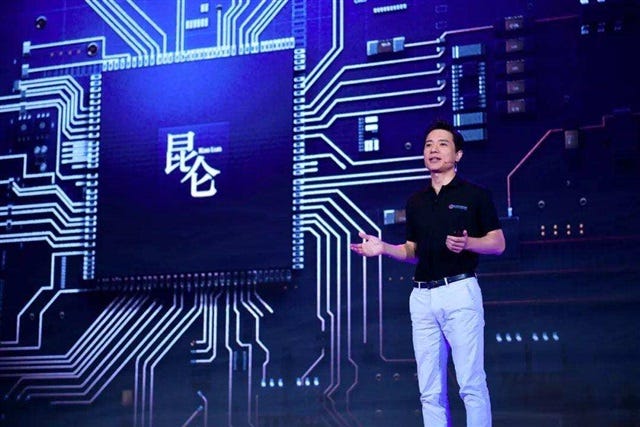
Baidu’s Kunlun chip division offers a case study.
Kunlun is a domestically-designed AI accelerator built to train and run large language models, the same class of chips that power ChatGPT and similar systems. In the first quarter of 2025, Kunlun deployed a 30,000-chip cluster capable of training models with hundreds of billions of parameters. By November, over 100 enterprise customers were running workloads on Kunlun silicon through Baidu’s cloud.
The commercial traction is accelerating. In August, Kunlun won over 1 billion Chinese yuan (roughly $140 million) in AI chip orders from China Mobile—one of the world’s largest telecoms. Chinese banks and state-owned enterprises are now deploying Kunlun to produce AI workloads in regulated sectors. This is far beyond pilot programs.
Industry analysts project Kunlun chip sales will increase sixfold in 2026. And Baidu isn’t alone. Alibaba just unveiled its T-Head PPU, manufactured domestically at SMIC, with performance benchmarks matching Nvidia’s China-focused H20. Huawei’s Ascend chips, which we’ve written about before, are shipping at volumes far exceeding earlier estimates—potentially 700,000 to 1 million units this year.
The Policy Takeaway
Export controls didn’t prevent China from building an indigenous AI chip ecosystem, and probably didn’t slow them. Export controls created a market for Chinese hyperscalers, going from being reluctant buyers of “good enough” domestic alternatives to active investors in parallel supply chains designed to be sanction-proof.
This doesn’t mean Chinese chips match America’s at the cutting edge. They don’t, yet. But for inference workloads, enterprise AI deployment, and cloud services, they’ve cleared the “good enough” threshold. That’s the bar that matters for adoption and market capture.
As ALFA has consistently argued, restricting American chip sales doesn’t constrain China over the medium to long term, it creates market openings for Chinese alternatives.

Commercial-First Foreign Aid
This morning, the State Department and aerial-delivery company, Zipline announced a deal to expand its life-saving blood delivery network in Africa.
From the announcement:
Under a new pay-for-performance model — a first-of-its-kind from the State Department — Zipline will receive up to $150 million to expand its AI and robotics infrastructure that enables African governments to provide 24/7 delivery of essential medical supplies to hospitals and health facilities. As buyers of the service African countries will pay up to $400 million in utilization fees. Funding will be released only when governments sign expansion contracts and commit to pay for ongoing logistics services to ensure long-term sustainability.
And it appears that African governments are grateful for this partnership.
With this partnership, we will now expand to urban delivery, bringing these benefits to even more communities. We thank the U.S. Government for supporting Zipline’s expansion and for joining us in building the foundation for Africa’s future in healthcare and innovation.
-Minister Paula Ingabire, Minister of ICT and Innovation, Government of Rwanda
The announcement notes that this agreement could “triple the number of hospitals and health facilities Zipline serves (from 5,000 to 15,000) and provide up to 130 million people with instant access to blood and medications.”
After the Trump administration moved USAID operations under the State Department, the legacy media breathlessly ran stories about how the U.S. was pulling back from the world stage and how critical support would be severed. Instead, this announcement shows that a commercial-first model will do more to help countries in need.