

J.P. Morgan’s $1.5 Trillion Plan to Re-Arm American Industry
Plus, Fixing Customs Fraud, Starship's Latest Launch, and the Army's Run at Shark Tank



In the very early 1900s, the American banker John Pierpont Morgan financed U.S. Steel into existence by consolidating Andrew Carnegie’s empire into the world’s first billion-dollar corporation. He bankrolled the railroads that stitched a continental economy together. And when the federal government lacked capacity to stabilize financial panics, Morgan personally organized private capital to backstop the system, locking other bankers in his library until they agreed to a rescue package.
Mr. Morgan wasn’t just an iconic industrialist; his contributions also made him one of the most important Americans in our country’s history.
Fast forward 124 years. Jamie Dimon—CEO of the bank that bears Morgan’s name—announced a 10-year, $1.5 trillion commitment to rebuild the muscle of American economic security: hard-edged industrial investment targeting the 27 sectors that determine whether America wins or loses the 21st century.
The Details
JPMorgan’s Security and Resiliency Initiative is divided into four operational zones covering 27 specific industries:
Supply Chain & Advanced Manufacturing: Critical minerals, pharmaceutical precursors, robotics
Defense & Aerospace: Defense tech, autonomous systems, drones, secure communications
Energy Independence: Battery storage, grid resilience, distributed power
Frontier Technologies: AI, cybersecurity, quantum computing
The bank quietly committed $1 trillion over the next decade to these sectors and Monday’s announcement adds another $500 billion, with $10 billion allocated to direct equity stakes in companies deemed critical to national security.
On a call with reporters yesterday, Dimon made two things clear about the initiative:
“This is not philanthropy. This is 100% commercial.” The bank expects market-rate returns.
The initiative started months ago as internal strategy, not reaction to recent events.
Why Now
The announcement comes three days after Washington and Beijing’s latest trade and tariff scuffle, where President Trump signaled 100 percent duties on Chinese goods in response to Beijing’s extraordinary rare earth export restrictions. On Friday, the NASDAQ lost 3.5% and the Dow Jones Industrial lost nearly 2%.
Monday saw a bounce back, but the signals are clear. And the government and private industry are already working to protect the future of our economy and security from rash retaliations from China.
To understand what’s at play, Reuters uncovered that JPMorgan has had “no less than 100 calls with clients” about replicating the MP Materials transaction—the rare earth mining deal in which the DoD took a $400 million equity stake this summer, with JPM providing the financing architecture.
Andrew Castaldo, JPMorgan’s co-head of mid-cap M&A said, “We’ve had numerous trips down to Washington to explore those opportunities with the government.”
The U.S. government is pursuing deals across up to 30 industries involving dozens of companies critical to economic security and JPMorgan is building the financial infrastructure for this public-private national security dealmaking.
What’s Next
The bank serves 34,000 mid-sized companies and 90% of the Fortune 500. When JPMorgan decides to deploy capital at scale, entire sectors move.
But as Dimon points out in a Wall Street Journal piece, private industry is not the only mover here:
Policy will be essential, too. America needs a permitting process measured in months, not years. Vocational and apprenticeship programs must be expanded to close the manufacturing skills gap. And we must create consistent long-term incentives for private investment in these critical industries so that more capital is available.
We’ve talked about this A LOT: Washington needs to get going on policy reforms that allow this capital to be put to use for the national interest.
Right now, the Executive Branch is leading this charge—most recently reissuing permits for the Ambler Road project in Alaska as part of its recent investment in Trilogy Metals.
But the Executive Branch executing these types of deals cannot be the only way projects are able to get moving.
Our mining needs are expansive. The ecosystem of hard tech startups is growing by the day. And America’s most storied financial backers are gearing up.
Are we going to let these new-age industrialists get to work to fortify American industry? Or are we going to make them wait in the queue until their number is called after what will surely be years of frivolous litigation and unnecessary hoop jumping?
Sometimes, the simplest inspiration can be found in unlikely places.
Podcaster and comedian Theo Von recently said, “nothing changes if nothing changes.” Despite this being said in the context of one’s personal journey, it’s a fitting reminder to policymakers that the task at hand is clear: it’s time to change the way we build in America.
Fixing Customs Fraud
Flexport’s Ryan Peterson described the increase in customs fraud and how to fix it yesterday on TBPN.

The digital freight forwarder and logistics platform CEO, made famous by his diagnosis and proposed solutions to the port backlog years ago, said this of the current customs fraud problem and a policy solution to fix it:
Right now the United States is the only country in the world that allows foreign companies to import goods into the country with no legal entity, no requirement to have an employee or person locally. So you can just import stuff into the country as a foreign company and then you just lie on your declarations. And our customs CBP has agents in like 60 countries, but they’re there for counter narcotics and anti-terrorism stuff. They’re not there for trade compliance and trade enforcement.
Right now, on the Amazon marketplace 60% of the sellers are non-resident importers from China.
So we’re trying to highlight this issue around Washington, and people have been really receptive to learn about it and to see how this works and to explore some ways that you might close this loophole.
Probably they [Washington] just need to make it so foreign companies, just like every other country in the world, need to have a legal entity in the country in order to import goods.
Test. Fail. Iterate. Succeed.

SpaceX successfully launched the final Starship flight of the current iteration last night at Starbase.
The mission achieved multiple objectives: deploying mock Starlink payloads, testing engine relighting, heat shield tiles, banking maneuvers, and controlled descent in the Gulf of America.
The next iteration will move toward orbital and deep space capabilities. With Version 2 retiring, the path is clearer for deploying upgraded designs with capabilities needed for orbital flights, lunar missions, and Mars ambitions.
Acting NASA Administrator Sean Duffy said after the launch:
Another major step toward landing Americans on the Moon’s south pole. The progress SpaceX demonstrated with today’s Starship test is critical for our Artemis missions. While we prepare for Artemis II, every flight strengthens our progress on Artemis III, and beating China back to the Moon!
Shark Tank For Defense
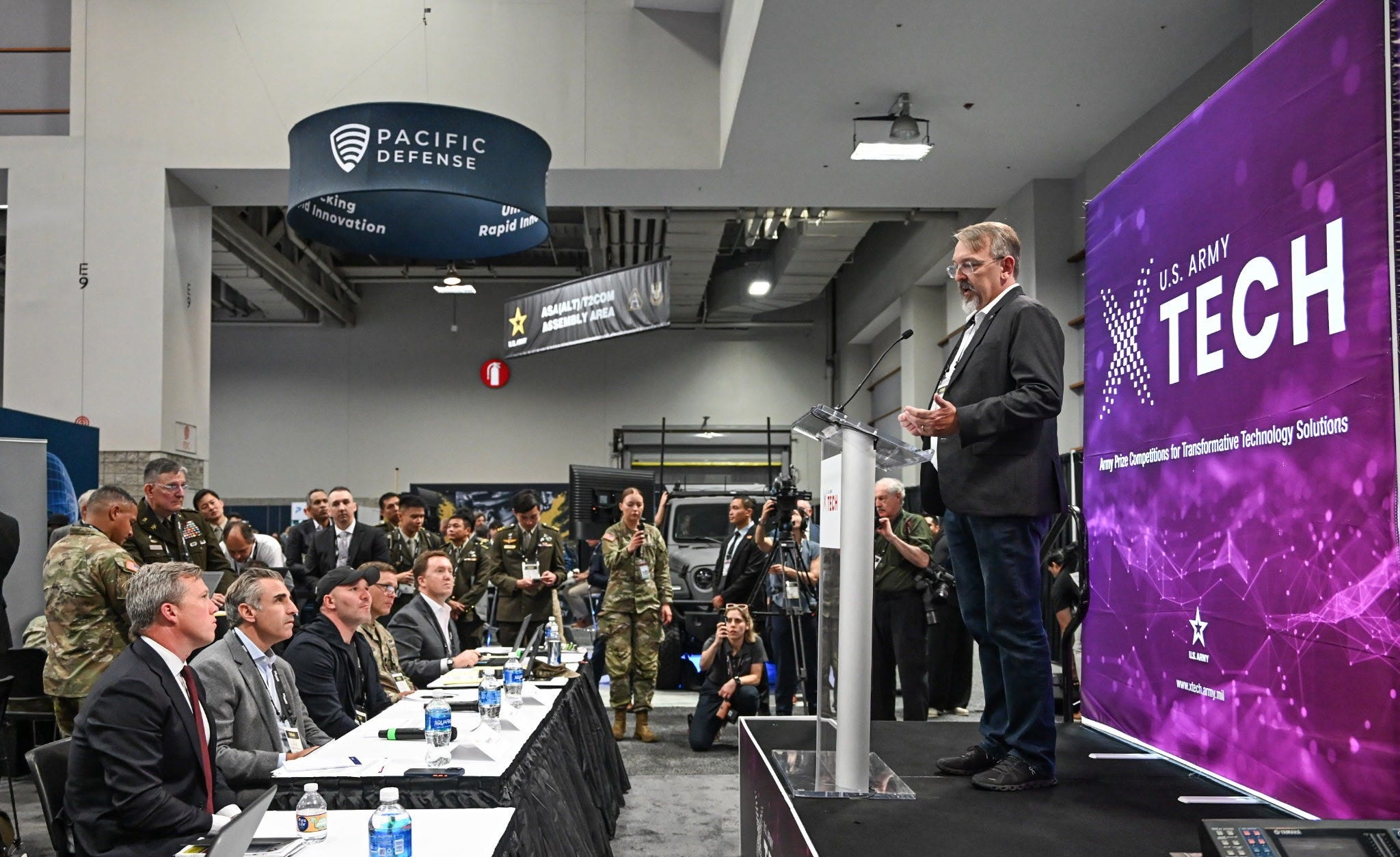
Yesterday at the annual AUSA Conference, Army Secretary Daniel Driscoll hosted a pitch competition for startups to win $500,000.
Recipients “sprint 30 days to build, then take their tech into the field for real-world testing.”
Breaking Defense, a top media source for innovation at the Pentagon, reports that Secretary Driscoll “vowed this morning that ‘organizational acquisition reform’ is on the horizon, promising to adopt a ‘Silicon Valley’ approach to getting tools, technology and weapons into the hands of soldiers faster than the traditional way of doing business.”
More from their dispatch:
The secretary’s comments come after the service announced the FUZE initiative last month — a venture capital-like acquisition model designed to speed up the private development of emerging technologies for soldiers. The program aims to invest $750 million over the next year and, as Driscoll announced this morning, it will increase to $765 million the next year.
“That’s an over 150 percent increase in the Army’s funding towards emerging tech and innovation,” he said.
One of the judges of the competition was podcaster and former Navy SEAL Shawn Ryan. His recent profile in the Wall Street Journal is worth the read.