

The Congressional Hackathon

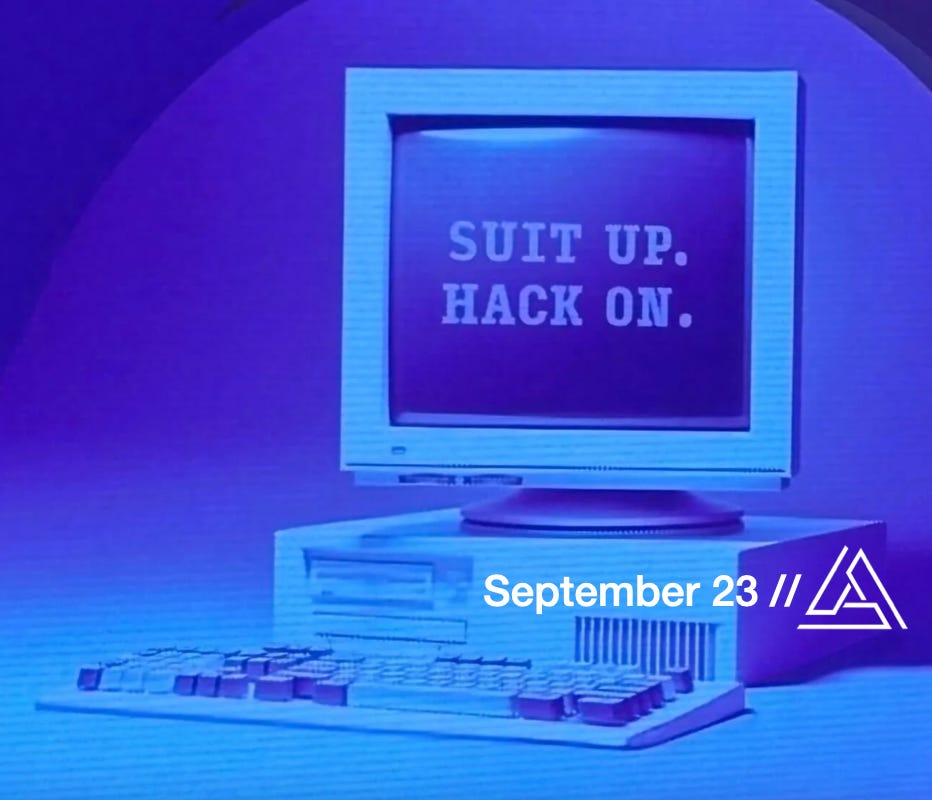
Last week about 250 people gathered beneath the Capitol dome to spend 5 hours building, demoing, and discussing new ways to pull Congress into the modern age.
This isn’t just about using AI to get with the times. It’s about our representative government better serving its citizens. And just like any major service-based enterprise, technology is the foundational tool to do that.
It’s easy to take that for granted and adopt a “just work with what you have” mentality. That’s especially true for a place like the Hill, where the constant workflow offers little time to reflect.
Luckily, there’s a growing cohort of former and current staffers who have been committed to logging the friction between how things are done and how they can be better, and dedicating themselves to bridging that gap.
The Congressional Hackathon started fourteen years ago following a meeting with Mark Zuckerberg and former House leaders, Eric Cantor and Kevin McCarthy. Spearheaded by our friend Matt Lira, it has produced real results for the institution, jumpstarted new business ideas, and forged relationships across party lines (perhaps the most vexing modern day challenge on the Hill).
This year’s event was entirely focused on, as you can imagine, AI. Perhaps that’s the reason it was the best attended in the event’s history.
Participation wasn’t the only barrier broken this year.
For the first time, there was a dedicated coding session that actually extended throughout the entirety of the event.
Tucked away in a meeting space off the Capitol Visitor Center auditorium, 90 coders from across the city (including NASA) spent time building tools that were suggested by the CAO and ones they felt deserved to be built.
By the end of the day, the group delivered ten projects including a committee data dashboard and a witness database that included 50,000 past witnesses of congressional committees. Other tools included AI-generated transcripts with diarization, which identifies who is speaking in the transcript (a useful tool when hearing participation reaches into the teens).
As a requirement, all the projects were open sourced and uploaded to GitHub for any other civic-minded engineer to keep working on.
Remarks from Speaker Mike Johnson and Senator Mike Rounds provided support from the highest levels of the Congress and a bicameral commitment to the mission. (A Senator speaking at the event was also a first.)
A one-hour lightning round provided updates on the API for Congress.gov, a legislative data map, and a renewed “digital bells” app that lets you know the progress of any given floor session (staffers can now confidently explain to visitors the difference between three bells and five bells).
The final session broke the attendees into groups and allowed nontechnical but forward-thinking staffers to ruminate on problem sets and potential solutions not just for their own workflow, but for constituents and anyone else interested in the work of government. Some examples include:
Clearly communicating available constituent services and offering accessible portals to them.
Proactive, as opposed to reactive, casework (i.e. opt-in push alerts on critical issues affecting the community).
AI-enabled defenses (screening external emails, agentic AI tools) against sophisticated cyberattacks and phishing scams.
Innovative hearings with roundtable formats, remote participation, tagging, and better data unification.
Congress is often referred to as “The People’s House.” But that’s too ambiguous. It should be the front porch, the library, and the dining room table. But without technology, it’s just not achievable.
The Congressional Hackathon isn’t just a once-a-year gathering of enthusiasts to nerd out on better processes. It’s strengthening the through-line between citizens and their government.
***
Keep an eye out for the event’s official report to the Hill on its findings and recommendations. But in the meantime, congrats to Chris Bien from the Speaker’s office and Steve Dwyer & Ananda Bhatia from the CAO on executing another successful event.
And for more on the history of the hackathon and why they are invaluable to an institution like the U.S. Congress, check out the latest conversation with Matt Lira and Shaun Modi. 👇
Field Notes
The National Design Studio released the website for the Trump Gold Card. Cover the url and you wouldn’t believe you were looking at a government site. Clean, beautiful, and super user friendly.
The announced $100 billion investment of NVIDIA into OpenAI is anchored to the deployment 10 gigawatts of AI infrastructure—the electricity equivalent to five Hoover Dams. This translates to four to five million GPUs, roughly double the number Nvidia shipped last year, representing massive future demand to finance semiconductor manufacturing capacity buildout. The first gigawatt of NVIDIA systems will be deployed in the second half of 2026.
From @SecretService: “The Secret Service dismantled a network of more than 300 SIM servers and 100,000 SIM cards in the New York-area that were capable of crippling telecom systems and carrying out anonymous telephonic attacks, disrupting the threat before world leaders arrived for the UN General Assembly.”