

Your Personal Flight Is Arriving Soon
The Department of Transportation's Advanced Air Mobility Strategy Will Change How We Travel


On December 19, 1903, the Wright brothers famously became the first in flight. Twenty-four years later, Charles Lindbergh made the first solo nonstop flight across the Atlantic. Jet airliners went mainstream by the late 1950s, the first commercial supersonic test flight followed in 1969, while the 1980s and 1990s saw major advances in flight control and GPS that made commercial aviation safer and more available than ever before.
Then, out of the blue, the breakthrough advances in flight we had come to expect stalled on the runway.
Now, one hundred and twenty-two years to the day from the Wright brothers’ first flight, the US Department of Transportation (DOT) has released the most advanced air mobility strategy in decades, a vision that fundamentally holds the potential to change how people and products move.
The 70-page document titled the Advanced Air Mobility (AAM) National Strategy offers up to forty policy recommendations across six pillars that will support the industry.
But first, what exactly is “advanced air mobility?”
Technically, it refers to electric Vertical Takeoff and Landing aircraft (eVTOL). Practically, it means very small aircraft or very big drones that can carry a few people or payloads to perform a critical task, such as fighting fires. For instance, the family living in Davis, WV no longer needs to drive over 3 hours to Dulles to catch a flight.
The document released late last year was set into motion by a June 2025 Executive Order which recognized “emerging technologies such as electric Vertical Takeoff and Landing (eVTOL) aircraft promise to modernize methods for cargo delivery, passenger transport, and other advanced air mobility capabilities.”
There is so much to unpack from the strategy and quite frankly, this post won’t come close to doing it justice. The future envisioned is so transformative and unique that humans will need to see it to believe it, which is something we intend to do in the coming months. Not to mention, policymakers will have their plate full to capture this technological, economic, and societal opportunity.
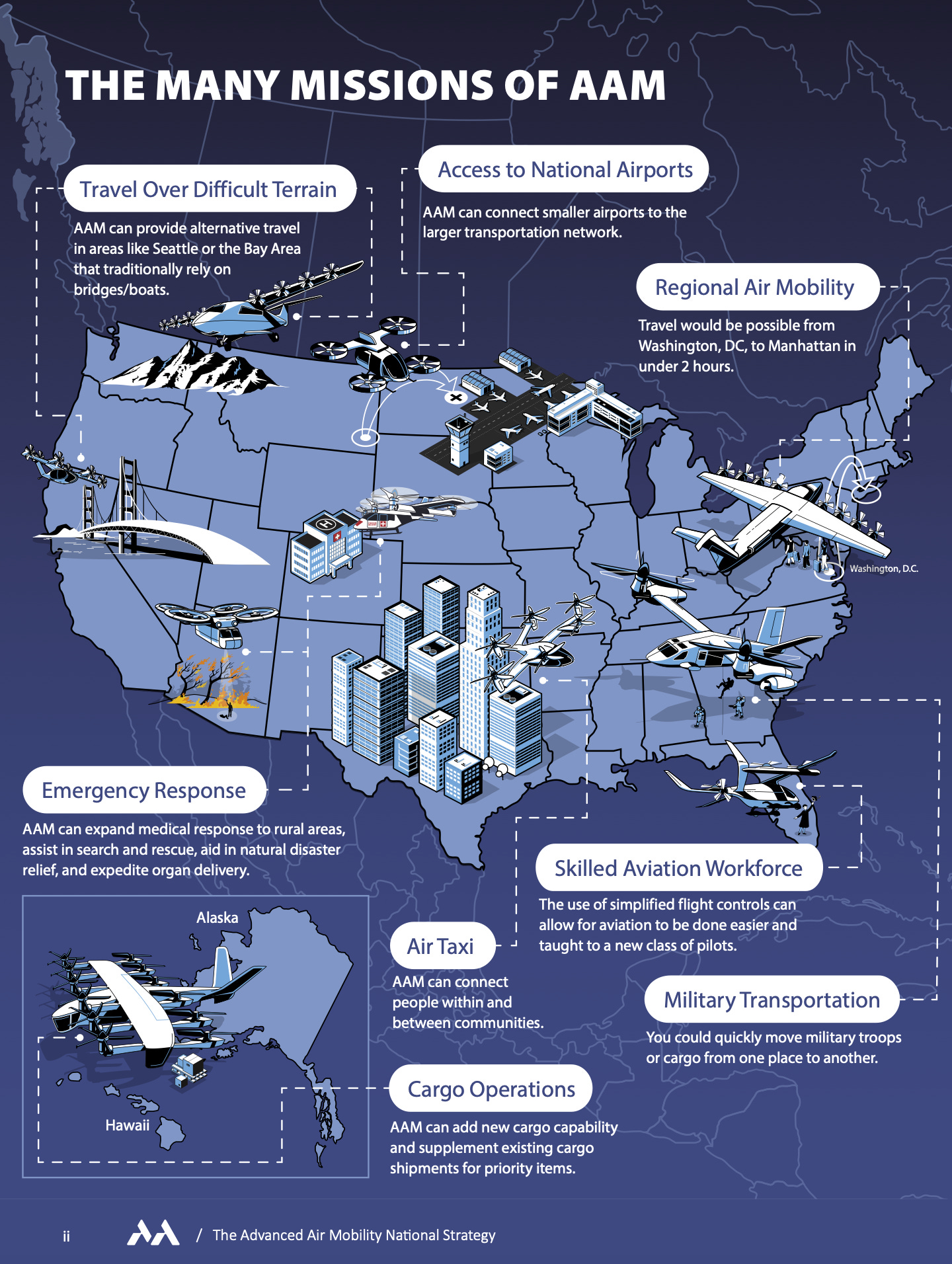
In the meantime, we thought it was important to start scratching the surface on what that strategy includes, particularly since there were zero stories from the legacy media upon its release.
So here are three notable recommendations from the strategy:
Third-Party Airspace Management
The Strategy green-lights a framework for private companies to provide air traffic management services in low-altitude airspace under Federal Aviation Administration (FAA) supervision, but not FAA operation. The document is explicit: “third-party services as envisioned would be neither [the pilot nor traditional air traffic control], but private companies providing services under government supervision.”
The FAA would retain regulatory authority, but the Strategy anticipates a future where commercial providers handle the actual traffic management for the thousands and eventually millions of daily advanced air mobility operations that the current system cannot absorb. In short, the government would set the rules while the industry operates within them.
Vertiport Design Standards
The report recommends that Unified Vertical Lift Infrastructure (launch pads for eVTOLs) combine existing heliport and vertiport guidance. That’s useful for municipalities navigating zoning and permitting. Even more interesting is that the Strategy explicitly asks Congress to fund planning grants for state, local, tribal, and territorial (SLTT) governments to figure out where and how to build advanced air mobility infrastructure. The document recommends a future approach that “funds a range of planning and engagement projects on a local level on a pilot basis.” The government would support the planning, so that private money would flow to laying cement.
New Careers
The Strategy also recommends updating Standard Occupational Classification (SOC) codes to include AAM-specific careers. Academic institutions cannot apply for federal workforce training grants without reference to an existing SOC code. If community colleges want to spin up eVTOL maintenance programs or aviation academies want to build remote pilot curricula, they’re stuck until the Department of Labor and the Office of Management and Budget in the White House creates the classification codes.
An FAA-led effort already identified 35 pre-operations occupations, 17 operations roles, and 31 jobs where AAM aircraft serve as tools. The codes exist in practice, they just need government recognition. The next SOC revision cycle targets the 2028 reference year. The Strategy pushes for data collection now so AAM careers make the cut. Congressional action through its workforce committees could accelerate this.
The Overview
Third-party airspace management tells eVTOL companies like Joby and Archer that there’s a path to scale without waiting for the FAA to hire ten thousand new controllers. Vertiport standards tell Ferrovial and real estate developers that their capital won’t get stranded by regulatory ambiguity. SOC codes tell Mesa Community College that training the next generation of aviation workers is a federally legible investment.
With just these three examples (and dozens more in the report) the message is simple: industry provides capital, government grants permission, and Americans will move more freely.
Committee Recap: Building an AI Ready America
The House Education and Workforce Committee held a nearly three-hour hearing this week on “Building an AI Ready America.” Witnesses from OpenAI and educational institutions studying and incorporating AI in the curriculum shared inspiring stories on how AI is improving the learning experience.
AI saves teachers up to 6 weeks of work per year on lesson planning and grading, freeing them to focus on students.
A story from a high school student described how AI helped her get better feedback on essays while making conscious choices about when to use it responsibly.
Physics classes using ChatGPT doubled student engagement and improved problem-solving skills.
Career and Technical Education teachers from industry backgrounds can now create excellent curriculum faster, helping students access great-paying jobs.
Education and Workforce Committee Chairman Tim Walberg told us:
AI is already having enormous impacts in American classrooms and throughout the workforce. Students, teachers, and workers are adopting AI not simply to move faster but to support learning, improve decision-making, and expand opportunity. However, it’s important we also understand the risks of AI. As this was the first in a series of hearings our Committee will hold on the impacts of AI, I look forward to exploring how we can leverage this technology to promote opportunities and safety for the American people.
This is exactly the type of congressional engagement needed to tell the AI story. Both sides of the aisle recognize the potential for the technology in real-world applications and having them hear it together, in the same room, and with open minds can serve as the foundation to build needed legislation.
Links Heading Into The Weekend
🔌 Trump and governors want an emergency power auction so that tech companies pay for new power plants
™️ Matthew McConaughey trademarks himself to fight AI misuse
⛏️ Rio Tinto and AWS contract brings new copper production in U.S.
🎸 Bob Lefsetz talks about Suno’s role in music creation
✈️ NASA Administrator Jared Isaacman is giving longtime NASA employees rides in his fighter jet