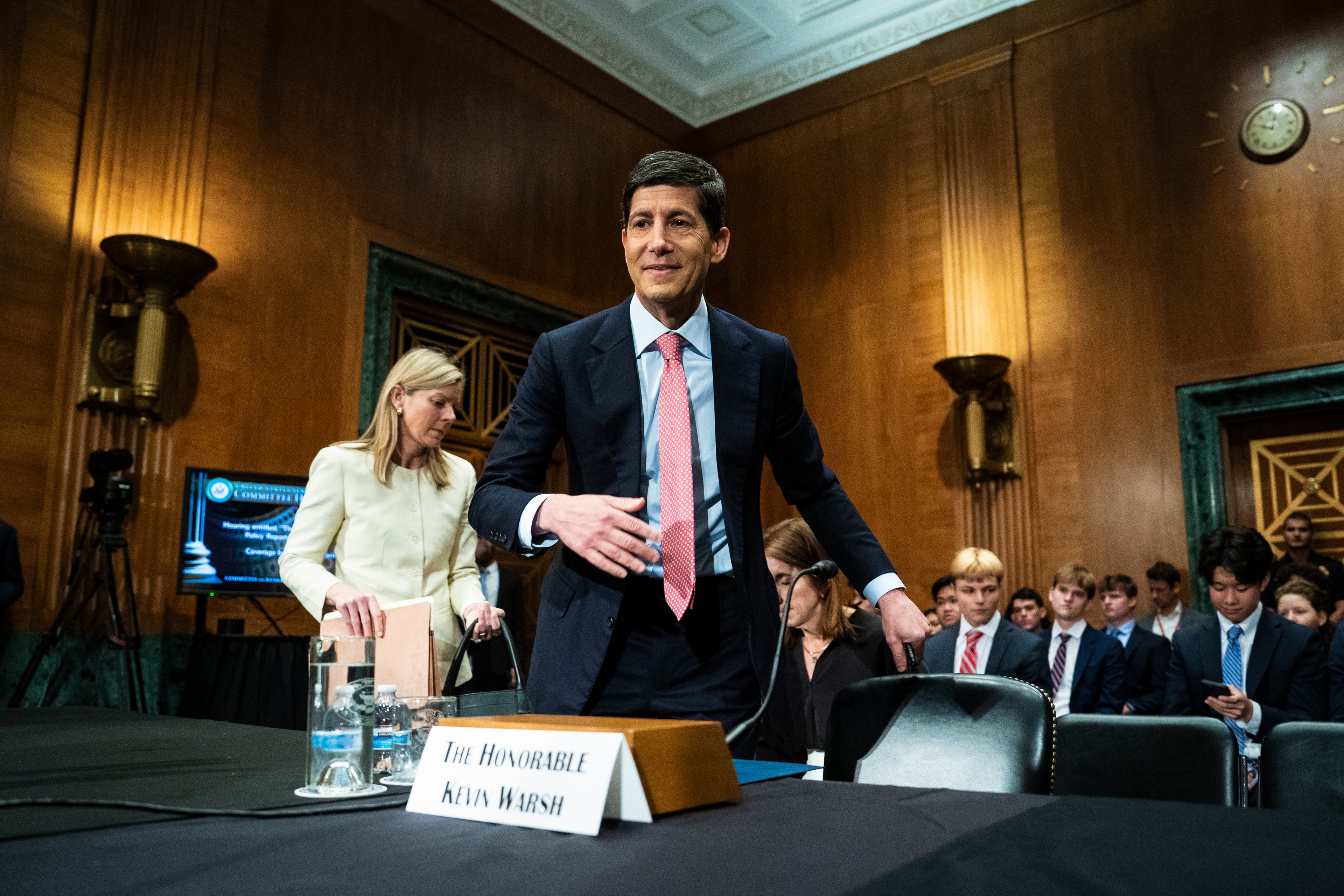
Federal Reserve Chairman Kevin Warsh is not a patient man. That's what he told the Senate Banking Committee on Wednesday morning about a few of the reform projects underway at the Fed. But patience appears to be his approach in assessing the impact of AI on the American economy.
AI-related investment, driven by data center construction, is booming, roughly 8% of gross domestic product according to a recent Bloomberg analysis. The short term effect of this, as Warsh said at the hearing, is good for jobs as the physical infrastructure is built out.
But others, including some Fed governors, believe that the spending on AI infrastructure is driving inflation as the demand for materials and labor has increased prices and strained supply.
The Wall Street Journal reported this week that the rising cost of building materials has led to a reduction in construction activity that isn't data centers.
Construction spending on manufacturing buildings dropped 22% year-over-year in May to a seasonally adjusted annual rate of $174 billion.
Materials costs for nonresidential construction are up more than 55% since early 2020 and even higher for fabricated steel, copper wire and some other individual materials, according to the government's producer price index.
Warsh isn't sold that AI spending is an inflation driver, though. This is where his "wait and see" approach comes in.
In response to a question from Democrat Senator Jack Reed, Warsh said "I don't view a one-time change in prices as necessarily being inflationary because I think there's a supply response."
Meaning, reindustrialization will pull us out of it. How quickly that can happen is still an open question.
"Will it [data center spend] increase measured prices over the course of the next 12 months? I suspect it will. Whether that's inflationary or not, that's up to the Federal Reserve, and we're going to have something to say about that," Warsh said.
That conversation within the Fed now includes new voices beyond Warsh himself, whose tenure started just seven weeks ago.
Earlier this month, Warsh announced the creation of five task forces led by economists, business leaders, and former central bankers to provide fresh perspectives that will support the Fed's decision making. As it relates to technology, the Productivity and Jobs Task Force will "assess the economic impact of new general-purpose technologies, including artificial intelligence, to inform the Federal Reserve's policy judgments," according to Federal Reserve.
Led by venture capitalists Marc Andreessen, Microsoft executive Asha Sharma, and Anthropic researcher Charles Jones (currently on leave), this Task Force will take the next several months to solicit inputs, think critically, and deliver its findings and recommendations to the Fed so that monetary policy is aligned with the economic changes that comes with transformational technology.
"We need to bring new ideas to the fore. After 63 months of inflation above the Fed's target, it struck me that any new leader that arrived at this institution should look to the very best minds we can find," Warsh told Senators.
One of the most pressing questions the Productivity and Jobs Task Force will help answer is AI's impact over the next two to seven years.
During Wednesday's hearing, Warsh expressed confidence that, in addition to the jobs boost from the AI build-out in the immediate term, the long tail of AI will improve productivity and wages. But what happens in between (those two to seven years) is murkier and "could have a disruptive effect."
Warsh's testimony in the House and Senate shows a Federal Reserve attuned to the most consequential technological impact our economy has experienced in generations. As new AI models are introduced regularly, Warsh wants to be sure America's central bank has a measured, but dynamic ability to achieve its mandate of full employment and stable prices. 
Sam Armour contributed to this piece.