

Our Water Infrastructure is Breaking
Plus undersea cables, humanoid imports, and human perseverance

ALFA has a new look, and we are grateful to designer Michael Gump for taking the time to understand our vision and deliver an inspiring brand to support it. We’re excited for the many ways we plan to incorporate this new look into our stories on technology, policy, and human ambition.
Three weeks ago, a major sewer line collapsed in Washington DC, resulting in close to a billion gallons of raw sewage entering the Potomac (spills are still ongoing). It is the largest sewage spill in U.S. history, causing immense ecological damage.
Had it occurred a few miles north, the U.S. capital city would be without drinking water for weeks.
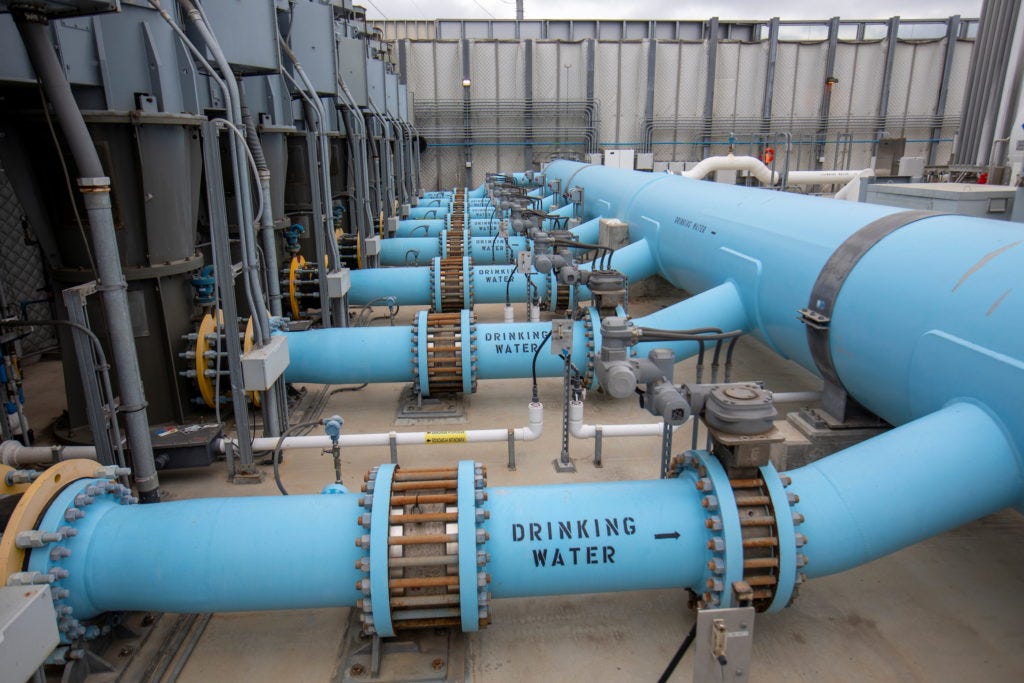
We hear a lot about critical infrastructure resilience, but the vast majority of those conversations revolve around our grid and sources of electricity. Far less attention is paid to the most fundamental human need: water.
But events like this in Washington should be a wake-up call to the vulnerability of the systems that deliver water, and how damaging the disruption of those operations could be.
The Potomac disaster is one of aging infrastructure (and a reminder of our struggle to build and repair physical infrastructure). But the notion of intentionally disrupting our water supplies isn’t lost on our adversaries.
In 2023 the FBI told Nick Lawler, the general manager of the Littleton, Massachusetts water utility that China had gained access to the utility’s system. The utility was one of 200 that were targeted.
No operational control was assumed, but the larger message was delivered: they were there and could be activated to disrupt or corrupt water quality at a moment’s notice.
In speaking with logistics leaders in government and business for some time, the brittleness of our water systems is routinely brought up as a “keep you up at night” scenario.
There are a stunning 170,000 water utilities in the U.S. Such a distributed network means the vast majority are small operations and do not have the technology or know-how to identify outside intrusions into their systems or, let alone, ward them off.
A Senate Environment and Public Works Committee hearing last week highlighted the challenges of small water utilities and talked about what could be done to strengthen resilience against adversarial attacks.
At the hearing, Senator Shelley Moore Capito (R-WV) noted “As we look to upgrade and modernize our water systems in the face of these threats, it is more urgent for our utilities, federal agencies and water sector and cybersecurity experts to work together to increase that system resiliency.”
And that “A one-size-fits-all mandate from the federal government will likely be overly burdensome and unworkable, particularly for our smaller systems, and can hinder utilities’ ability to take achievable steps towards meaningful progress.”
Whenever there is a water line break in your neighborhood you know the inconvenience it can cause. Now imagine that at city-wide scale for extended periods of time and with far more severe public health and ecological consequences. That is a real threat on the table, and one our government and private sector must work together to mitigate.
Field Notes
🚢 Undersea Cables Bill Advances
Last year, we wrote on another resiliency threat: cables carrying internet and digital information across the ocean floor:
Our world is now a digital one and these cables can serve as the backbone of the internet by “carrying about 95 percent of intercontinental global internet traffic” — making sabotage to this data infrastructure an increasingly rich target. Damage to these data delivery pipelines could be crippling to the tasks we look to perform everyday.
The answer to this concern is cable resiliency. What that means: more routes in which underwater cables can be laid.
This week the House passed legislation on a bipartisan basis to do this by allowing undersea fiber-optic cables to be installed and maintained in certain marine areas without duplicative (and elongated) federal review.
🤖 Commerce Policy on Humanoids Imports
At an event hosted by Breitbart News, ALFA, and CGCN, Commerce Secretary Lutnick noted that the U.S. will impose a no entry strategy to humanoid robots from China.
“We’re not going to let Chinese humanoid robots into this country, just like we’re not going to let Chinese electric vehicles into this country.”
Embodied AI (robots) could be “the biggest industry in the history of the planet” and China isn’t waiting to build it. The ALFA Institute noted that “over 30 Chinese companies are now building humanoid robots—compared to fewer than 10 in the U.S.”
A committed U.S. strategy to capture leadership in robotics will require coordinated industrial policy, supply chain resilience, and a regulatory framework that accelerates domestic innovation rather than constraining it.
🥍 Point of Personal Pride
This isn’t a tech or policy story, but one of the human spirit. And as the lines blur between tech and what makes us people, we believe it is important to celebrate the intangible qualities that don’t maximize for immediate success but build stronger foundations.
Tonight, the top-rated University of Maryland lacrosse team takes on the second-ranked Syracuse University. In goal for Maryland is a redshirt senior named Brian Ruppel, who also happens to be my nephew and godson. This week the Baltimore Sun profiled Brian and his journey over the course of three years from starter, to back-up, to starter again.
At a time of “what’s in it for me?” or leaving for assumed greener pastures at the first sign of adversity, his commitment to something greater than himself is a quality that our institutions could use more of, and one our family is immensely proud of.
Go Terps.
