

The “Media” is Dead. Long Live the Media.

There once was a trend among (primarily) tech and political leaders to try and bypass the traditional information gatekeepers (i.e. legacy media) and go direct to their core constituencies with news they wanted to share; be it a business decision, legislative update, or personnel announcement. The concept made sense: don’t outsource your message to someone else who doesn’t have the same type of skin in the game. A post introducing this has 22 million views.
Tech leaders like Coinbase CEO Brian Armstrong were early adopters, using it as a high stakes strategy to front-end negative and inaccurate reporting on the company. Through periods of strained relationships with the Capitol Hill press corps, we sought to implement it as well. But maintaining this cadence is hard (for reasons we will get to).
We were recently talking with a veteran comms professional who pointed out that the tech community who once swore off legacy media has been increasingly looking to them to spread their message.
Anthropic CEO Dario Amodei was on a media tour de force at the World Economic Forum and regularly shares his message on AI impacts to outlets like Axios1, while news of partnerships between tech companies and energy producers ricochet throughout legacy media weekly.
Heck, even Kanye West took out a full-page ad in the WSJ this week to apologize and share news on his bipolar diagnosis and struggle with the disease.
Why the Snapback?
The first (and obvious) reason is that building audiences is hard. Forget content creation, content distribution is a 24/7 job.
But the second reason is structural and dovetails with a more general appreciation that Washington is no longer a laggard to tech developments but rather becoming an integral partner. Before technology companies were building in highly regulated industries (i.e. energy, defense, space, and transportation) the Washington audience was a ‘nice to have’ but not necessarily a ‘need to have’. Advancements in nuclear energy, investments in energy infrastructure, and entirely new modes of transportation are as important as ever to the capital community. And your average consumer in the beltway does not live on tech twitter or pay the hefty price tag for platforms like Stratechary.
That has created an opportunity for legacy, DC-based media to trade in coverage of the political horse race for the technology race.
Yes, but …
The irony of today’s growing media ecosystem (what Axios describes as “shards of glass”) is that there are fewer authoritative outlets to tell your story. Yes, new-ish companies such as Punchbowl, Axios, and Semafor are thriving. But their newsletter-first format, which prioritizes speed and insight, doesn’t always lend itself to the type of storytelling that builders and policymakers sometimes prefer2. Also, these new outlets didn’t supplement the media landscape of the past; they replaced much of it. What exists today is a supply and demand imbalance for information (lots of content, less willing publishers of it).
As a result, many companies and agencies still look to go direct on their channels first to distribute news. For instance, the Department of Energy routinely publishes articles on X with investment and deregulation announcements. And the substack community counts a growing number of established businesses on the platform. These channels are suitable for news as a commodity. But stories with an intended shelf life and that are meant to be cited, remembered, or revisited need something more.
Artifacts
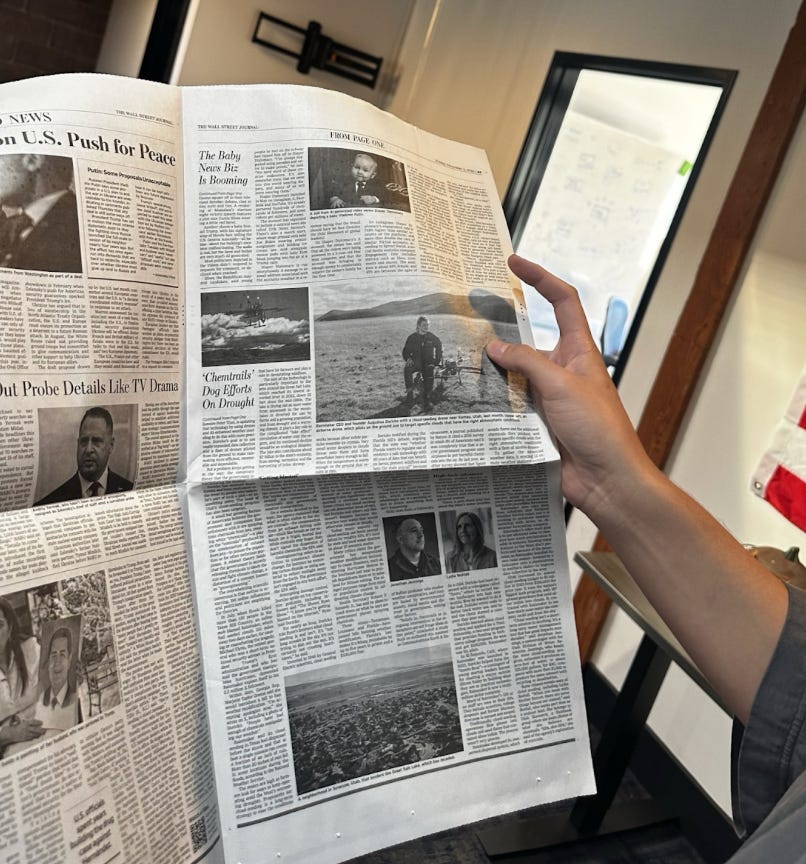
Some media isn’t just consumed. It’s collected. Take the WSJ profile on Rainmaker that landed on the front page of its print edition:
Or the profile of media startup TBPN in the New York Times:

Or any other piece of physical media.
They aren’t just pieces of content, they’re artifacts. They sit on tables, circulate among C-suites, are displayed by other media, and of course, framed in homes and offices. They suggest a seriousness that your feed simply can’t replicate alone.
If you’ve ever been involved in a story that becomes physical, you know that you’ll cherish it forever.
This isn’t about nostalgia or novelty. Rather, in an ecosystem filled with countless publishers, authority has become scarce. And scarcity is precisely what gives the media its power again.
What Comes Next
One of the more interesting predictions for the coming year is the migration of successful individual voices to establishing their own media companies.
These contributors will likely turn their popular newsletter into something more. And in some instances, it’ll incorporate some of the above characteristics.
The opportunity for this isn’t just because it feels that our feeds have been hijacked, but because attention alone is no longer enough.
In this next phase, the outlets that matter most won’t always be the loudest or the fastest, but the ones trusted to turn stories into history.
One could argue that Dario’s consistent emphasis on the negative impacts of AI has a home with legacy media. Regardless, if there was one message coming out of Davos he owned a big share of it.
And of course, reaching the brass ring of long-form podcasts such as Joe Rogan is elusive.